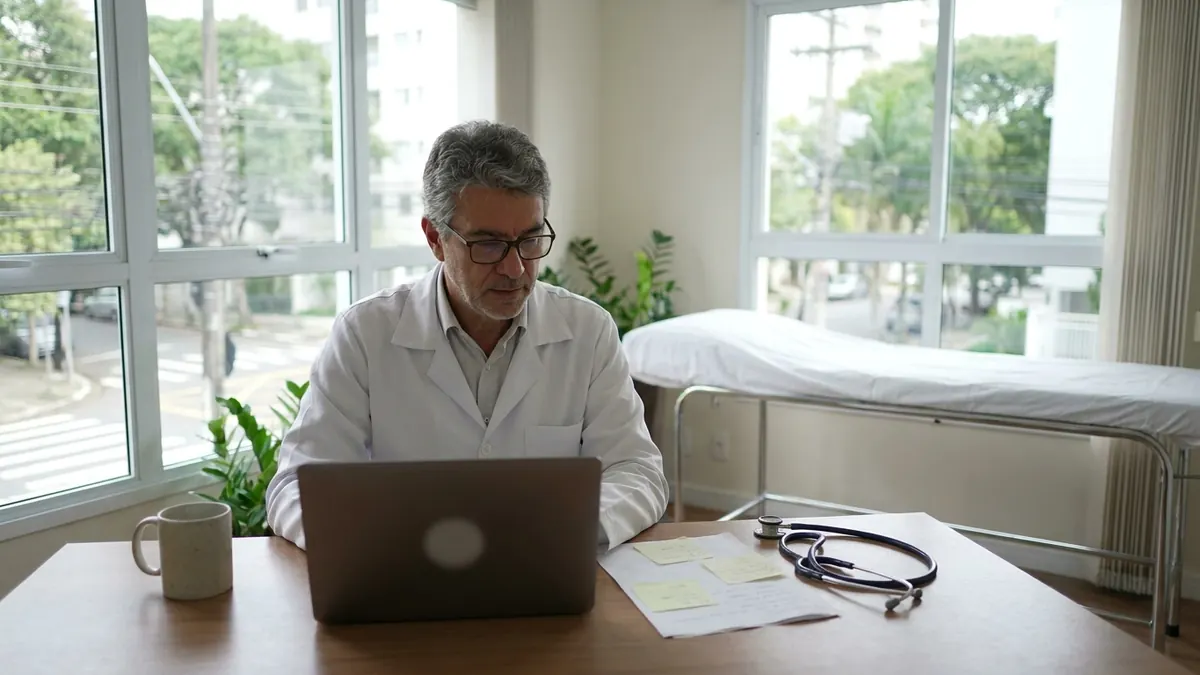
It's 7:40 p.m. on a Tuesday. Your last patient left an hour ago, and you're still in the office with 14 notes open in the EHR, two prior authorization requests the insurer bounced back, a referral letter to cardiology and a patient portal inbox with 31 unread messages. Most of those messages ask the same thing: "Can I get in this week?" None of that is medicine. It's the paperwork medicine leaves behind, and it's the reason so many physicians call it "pajama time."
That leftover work is where AI for medical practices pays off in 2027. It doesn't examine anyone, it doesn't pick the treatment and it doesn't sign. It drafts, it reorganizes messy text and it answers the person who wants an appointment at 11 p.m. This guide is the map: task by task, which tool I'd use, what it costs in dollars, what you should never paste into it and where it fails.
AI for medical work: what the machine gets and what stays with you
The split that has worked best for me is simple: AI handles text and logistics; you handle clinical judgment. Respect that line and you save a lot of time at low risk. Cross it (asking for a diagnosis, a dose or a treatment plan and using it without review) and the risk climbs fast, while the liability stays exactly where it was: with the licensed physician. No state medical board accepts "the chatbot wrote it" as a defense.
| Task | Tool I'd use | Time it usually saves | Risk |
|---|---|---|---|
| Visit note from your own shorthand or a recording | An ambient AI scribe with a BAA (Abridge, Dragon Copilot, Freed, Heidi) or the one built into your EHR | 1 to 2 hours a day for a full clinic | Medium: read every line before signing |
| Prior authorization and appeal letters | ChatGPT or Claude on a plan with no training on your data, de-identified input | 15 to 20 min per letter | Low if you check the criteria |
| Referral letters and work or school notes | ChatGPT, Claude or Gemini | 10 min per document | Low |
| After-visit instructions in plain English | Any of the three, from your own text | Large over time: it becomes a template | Low |
| Scheduling, confirmations, waitlist | A text-message agent or your practice management system's module | Hours per week of front-desk time | Low, with a "symptom = human" rule |
| Reading papers and guidelines | OpenEvidence, NotebookLM, Claude | Half the time of a critical read | Medium: AI invents citations |
| Instagram, TikTok and patient newsletters | ChatGPT or Claude with your rules in the prompt | 1 hour a week | Medium: board and FTC rules apply |
| Diagnosis and prescribing | None, on its own | - | High |
The last row says "on its own" on purpose. Asking for differentials you may have missed is studying. Pasting the answer into the chart is handing off a medical act.
The rule before any prompt: HIPAA and protected health information
Patient data in the U.S. is protected health information (PHI) under HIPAA. If a vendor stores or processes PHI on your behalf, you need a Business Associate Agreement (BAA) with that vendor. The consumer versions of ChatGPT Plus, Claude Pro and Gemini do not come with one. Some enterprise and healthcare plans, and the APIs of the big model companies, can be covered by a BAA for eligible customers, but you have to sign it; it isn't automatic.
In practice, that leaves two safe paths:
- De-identify before pasting. No name, date of birth, MRN, address, phone, email, insurance ID, exact dates of service or rare details that point to one person ("the only lung transplant patient in a town of 2,000"). HIPAA's Safe Harbor method lists 18 identifiers; treat that list as your checklist.
- Use a tool covered by a BAA when you need real patient data: an ambient scribe, your EHR's built-in AI or an enterprise plan your practice signed.
One more layer: turn off "use my data to improve the model" in any paid chat you use for work, even with de-identified text. And check your state. California, for example, passed a law (AB 3030) that requires a disclaimer when generative AI writes clinical communications to patients without a provider reviewing them. The safest habit works in every state anyway: you read it before the patient does.
AI in the exam room and after it: 5 real cases, with prompt and output
1. A clean note from your own shorthand
If your EHR doesn't have a scribe yet, this is the bridge. You type the way you think and the AI puts it in SOAP format, without inventing anything.
Turn the de-identified shorthand below into a SOAP note (Subjective, Objective, Assessment, Plan). Rules: do not add any finding, history or plan that isn't in my text; mark anything ambiguous as [VERIFY]; keep my wording for the assessment; bullet points, no more than 180 words.

Shorthand: [PASTE]
Tested with: "52M, HTN on lisinopril 20. 3 wks intermittent HA, worse AM. no vision change, no weakness. home BP 150s/90s. exam BP 158/94, neuro nl, fundi not done. plan: incr lisinopril 40, BMP 2 wks, BP log, RTC 4 wks, ED if worst HA of life / focal deficit."
S: 52-year-old male with hypertension on lisinopril 20 mg. Three weeks of intermittent headache, worse in the morning. Denies vision changes and weakness. Home BP readings in the 150s/90s.
O: BP 158/94. Neuro exam normal. Fundoscopic exam not performed.
A: Hypertension, uncontrolled. Headache [VERIFY: link to BP stated or implied?].
P: Increase lisinopril to 40 mg daily. BMP in 2 weeks. Home BP log. Return in 4 weeks. Go to the ED for worst headache of life or any focal neurological deficit.
It flagged the one thing I hadn't written explicitly. That [VERIFY] tag is the whole point of the prompt.
2. Prior authorization letter that answers the payer's criteria
Prior auth is where AI earns its subscription in a U.S. practice. Insurers deny for missing elements, not because the drug is wrong. So feed it the payer's own criteria.
Write a letter of medical necessity for [DRUG / PROCEDURE] for a de-identified patient. Use ONLY the clinical facts below. Organize it so each criterion from the payer policy is answered in order, with a heading per criterion. If a criterion has no supporting fact in my notes, write [MISSING: what's needed] instead of filling it in. Professional tone, under 350 words.

Payer criteria: [PASTE THE POLICY CRITERIA]
Clinical facts: [PASTE DE-IDENTIFIED SUMMARY]
The [MISSING] tags are what save the second round of denials. In my test with a GLP-1 request, it flagged "documented trial of metformin, dates and outcome," which was exactly the gap the reviewer would have caught.
3. After-visit instructions a patient actually follows
Rewrite the instructions below for an adult patient at a 6th-grade reading level. Sentences of 15 words or fewer. Bullets. End with "Call us or go to urgent care if:" using only the warning signs in my text. Do not add any medication, dose or advice I didn't write.

Instructions: [PASTE]
Tested with: "Acute viral bronchitis. Supportive care. Honey/warm fluids for cough, OTC acetaminophen PRN fever. Cough may last 3 wks. No abx indicated. RTC if fever >3 days, SOB, chest pain, bloody sputum."
What you have: a chest cold caused by a virus. Antibiotics do not work on viruses.
What to do at home:
- Drink warm fluids. A spoon of honey can calm the cough.
- Take acetaminophen (Tylenol) if you have a fever. Follow the label.
- The cough can last up to 3 weeks. That is normal.
Call us or go to urgent care if:
- Your fever lasts more than 3 days.
- You feel short of breath.
- You have chest pain.
- You cough up blood.
Faithful, no extras. It added the brand name Tylenol for clarity, which I'd keep; you may not.
4. Reading a paper without falling for fake citations
General chatbots still invent references that look perfect: real journal, plausible authors, a DOI that leads nowhere. Two habits fix it. First, use a tool that searches real literature (OpenEvidence is free for verified U.S. clinicians) or upload the PDF yourself to NotebookLM or Claude. Second, use this prompt:
Using ONLY the attached paper, give me: study design, population, primary outcome, effect size with confidence interval, main limitations the authors admit, and one limitation they don't mention. Quote the page or section for each item. If something isn't in the paper, say "not reported." Do not cite any other source.
5. A post that stays inside the rules
Doctors on social media in the U.S. answer to the state medical board (advertising and testimonial rules vary by state), to HIPAA (no patient photos or stories without written authorization) and to the FTC (no misleading claims, disclosed sponsorships). Put the rules inside the prompt:
Write an Instagram caption (max 120 words) explaining [TOPIC] to the general public. Rules: educational tone; no promise of results; no before-and-after; no mention of any patient; no price or discount; no comparison with other doctors; end with "This post is educational and does not replace a visit." Then list any sentence that could break state medical board advertising rules.
AI tools for doctors: price and when to use each one
Prices change, so treat these as "starting at" and confirm on the official site.
| Tool | Price (2026) | What it does well | Watch out for |
|---|---|---|---|
| ChatGPT Plus | US$ 20/month | Letters, instructions, prior auth drafts | No BAA on consumer plans: de-identify |
| Claude Pro | US$ 20/month (less on annual) | Long documents, careful writing, uploads | Same: no BAA on consumer plans |
| Gemini (Google AI Pro) | About US$ 20/month | Works inside Gmail and Docs | Workspace settings decide what's covered |
| OpenEvidence | Free for verified U.S. clinicians | Answers with citations from the literature | Still read the source it cites |
| Doximity GPT | Free for verified clinicians | Letters and patient handouts | Check its current HIPAA terms before using PHI |
| Ambient scribes (Abridge, Dragon Copilot, Freed, Heidi) | From free tiers to about US$ 100+/month per clinician; enterprise priced by quote | Notes from the conversation | Sign the BAA; get patient consent to record where your state requires it |
| NotebookLM | Free | Studying from PDFs you upload | Only as good as the files you give it |
If I had to pick one paid tool for a small practice this month, it would be an ambient scribe covered by a BAA, because notes are where the hours disappear. If budget is tight, one general chat at US$ 20 plus de-identification gets you most of the gain on letters and prior auth.
Where AI gets medicine wrong (and sounds sure about it)
- Doses and interactions. It can mix up mg and mcg, pediatric and adult dosing, or renal adjustments. Never take a number from a chatbot without checking Lexicomp, UpToDate, the label or your pharmacist.
- Citations. Covered above. If you can't open it, it doesn't exist.
- Guidelines. It may quote the 2019 version of a guideline updated in 2025. Ask for the year and check the society's site.
- Scribes that "hear" things. Ambient notes sometimes add an exam finding you didn't do ("lungs clear") because it's common. Read the Objective section line by line.
- Billing codes. It will suggest E/M levels and ICD-10 codes confidently. Coding is a compliance issue; let your coder or the official code set decide.
Common mistakes doctors make when they start with AI
- Pasting a full note "just once" with the name still in the header.
- Using the free version at work and never turning off data training.
- Letting the scribe sign off on its own because "it's usually right."
- Asking a vague question ("what should I do for this patient?") instead of a task ("rewrite this for a 6th-grade reader").
- Buying three tools at once. Start with one, measure the hours, then add.
- Forgetting the front desk. Often the biggest win isn't in your notes; it's the phones.
What the AMA, HHS and the FDA already say
The American Medical Association uses the term "augmented intelligence" on purpose: AI supports the physician, it doesn't replace clinical judgment. Its policy asks for transparency, physician oversight and clear liability rules, and it has published guidance on how practices should evaluate AI tools before adopting them. HHS enforces HIPAA, which covers any PHI you put into a tool. The FDA regulates some AI as a medical device and has guidance on clinical decision support software; the chat tools in this article are general-purpose and are not cleared to diagnose. None of these bodies forbids you from using AI for writing and organization. All of them expect you to stay accountable for what reaches the patient.
Where to start this week
Pick the task that eats the most time and fix only that. For most outpatient doctors, it's one of two things. If it's documentation, run an ambient scribe trial with a BAA for two weeks and count the minutes after clinic. If it's the phones and the portal, look at your no-show rate; a practice with 400 visits a month and 12% no-shows at US$ 150 a visit is leaving about US$ 7,200 a month on the table. That's the case for a scheduling agent, and I walk through how one works in AI for doctors: the front-desk agent that books, confirms and cuts no-shows. For the daily writing, the 20 prompts in ChatGPT for doctors: 20 tested prompts are ready to copy.
Want to skip this part?
Ready-made AI agents for medical practices: nothing to build, no prompts, they already work for you by text message.
- Book, confirm and reschedule visits 24 hours a day
- Offer cancelled slots to your waitlist automatically
- Never answer symptoms: they hand off to your team with a summary and an urgency flag
Step by step
- Pick one paid AI tool and turn off the option that lets it train on your data.
- Write down the 18 HIPAA identifiers and remove them from anything you paste into a consumer chat.
- Turn the five instructions you repeat most into plain-English templates.
- Test the SOAP prompt on three closed cases and compare it with your own note.
- Run a two-week trial of an ambient scribe covered by a BAA and count the minutes after clinic.
- Measure your no-show rate before deciding on a scheduling agent.
Frequently asked questions
Can a doctor use ChatGPT at work?
Yes, for writing, studying and organizing, as long as you review everything and never paste PHI into a consumer plan. The medical decision and the signature stay with you.
Is ChatGPT HIPAA compliant?
The consumer plans (Free, Plus) do not come with a Business Associate Agreement, so they are not for PHI. Some enterprise, healthcare and API offerings can be covered by a BAA for eligible customers; you must sign it first.
What is the best AI for doctors in 2027?
For notes, an ambient scribe with a BAA. For letters and prior auth, ChatGPT Plus or Claude Pro with de-identified text. For literature, OpenEvidence, which is free for verified U.S. clinicians.
Will AI replace physicians?
No. It removes paperwork. Diagnosis, the conversation with the patient and accountability stay with the physician, which is also the AMA position on augmented intelligence.
How much does AI cost for a small practice?
A general chat is about US$ 20 per month per user. Ambient scribes range from free tiers to around US$ 100 or more per clinician per month. A scheduling agent usually costs less than two or three recovered visits a month.